

READ Academy of Sacramento
When Emotions Run High in the Classroom
The research behind what is driving your child's anxiety at school.
By Dr. Leah Skinner, ED.D | April 2026
Key Takeaway
When a child starts shutting down, avoiding schoolwork, or melting down in the classroom and at the kitchen table, it is almost always treated as an emotional or behavioral problem.
In 1925, neuropsychiatrist Dr. Samuel Orton challenged that assumption by identifying a pattern in children with average or above-average intelligence who were failing to learn to read. The anxiety, avoidance, and emotional distress did not come first. They appeared after reading instruction began.
The reading difficulty comes first, not the other way around. In many cases, the anxiety is the result of instruction that does not match how a child’s brain processes language.
Most families do not come in asking about reading, writing, or math. They come in talking about anxiety and the emotional struggles their child is having at school. It is something I know all too well, both in my work and as a parent of five neurodiverse children.
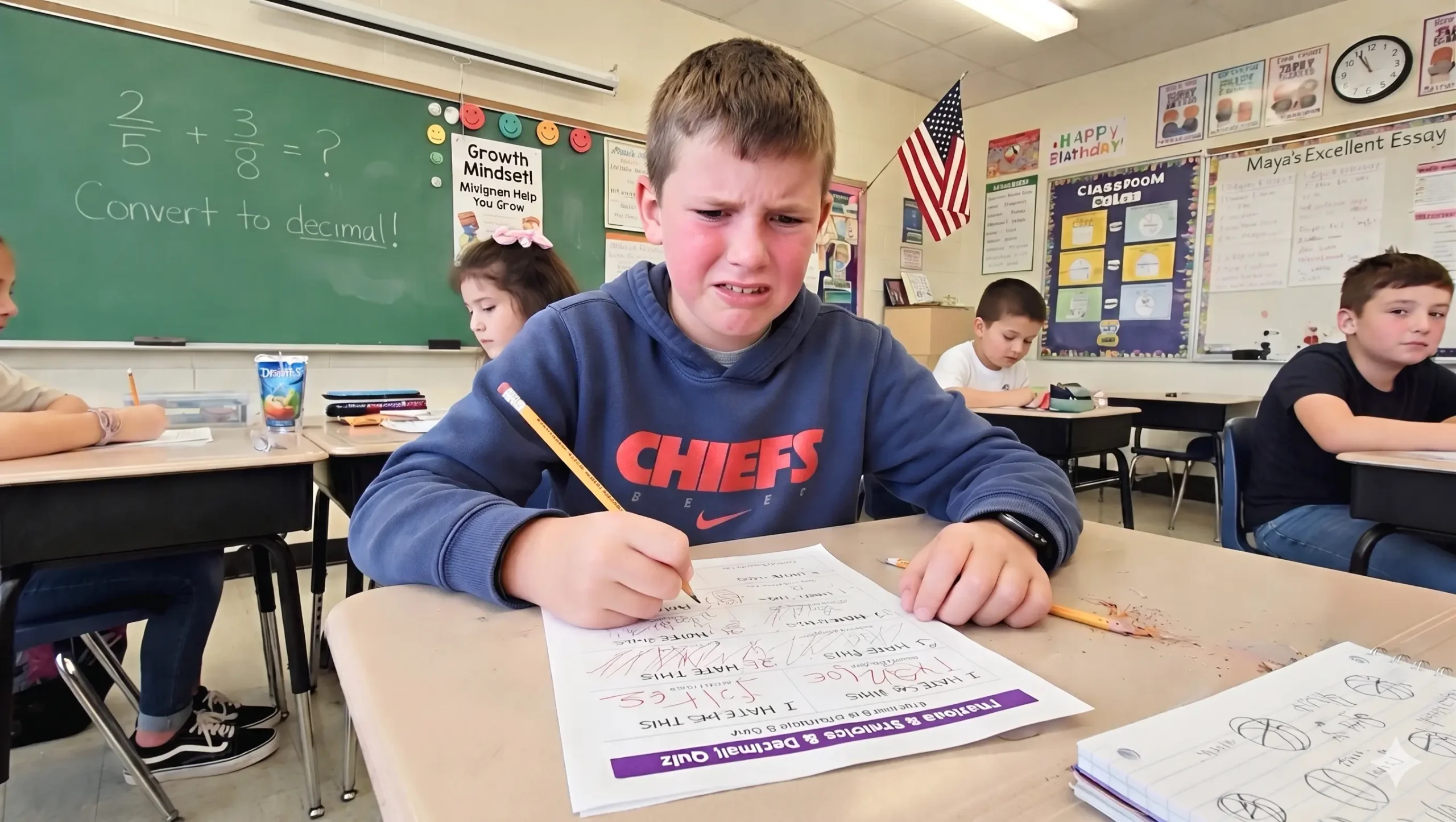
They tell me their child used to love school. That something changed when reading, writing, or math became part of the day. First grade, second grade, sometimes later. A child who was fine begins to avoid it, then resist it, then shut down around it.
By the time they sit down with me, they have usually done what the school suggested. Extra help, more practice, more time.
But the anxiety is not the problem.
It is the signal.
Underneath it is a difference in how their child processes language. If that difference is not understood, the instruction does not match how they learn. The effort goes up, and the progress does not. That is the part that needs to be identified.
Dr. Leah Skinner, ED.D., Founder, READ Academy of Sacramento
The Pattern You Are Watching Unfold
It is not a phase. It is not laziness. And it did not start until school did
Your child was fine before school got hard, curious, engaged, and happy. Then something changed. Maybe it was first grade, when reading shifted from picture books to paragraphs. It could be second or third grade, when the expectation moved from learning to read to reading to learn.
At some point, the child who used to love school began to dread it.
You see it at home and hear about it from school. The teacher calls about a meltdown during reading. At home, homework drags on for hours and ends in tears. Your child avoids reading out loud, says they are stupid, says they hate school, and says their stomach hurts every morning before school.
Most families have already tried what was suggested. Counseling, behavior plans, and more practice. None of that is wrong, but none of it explains why a child who used to love school now dreads it.
What changed between the child who loved kindergarten and the child who is falling apart in third grade?
In most of the families we work with, the answer is this: the method of instruction changed. And it no longer matches how their child’s brain processes language.
Dr. Samuel Orton Identified This Pattern in 1925
A neuropsychiatrist who studied brain damage in adults turned his attention to children who could not read
Dr. Samuel Torrey Orton (1879-1948) was a neuropsychiatrist and pathologist working with adults who had suffered brain injuries. He understood how specific regions of the brain affected language processing. In the 1920s, he turned his attention to children with no brain injury who were failing to learn to read.
In 1925, he evaluated students referred for academic failure. Fourteen had only reading difficulties, and every one of them had average or above-average intelligence. These were not children who could not learn. They were children whose brains processed written language differently.
Orton rejected the idea that reading failure was a vision problem. He argued it was neurological. He introduced the term “strephosymbolia,” meaning “twisted symbols,” to describe what we now call dyslexia. The emotional and behavioral symptoms appeared after reading instruction began.
Orton did not find a problem with the child. He found a mismatch in the instruction.
From Observation to Instruction
Orton identified the pattern and explained why these children were struggling. But understanding the problem and teaching a child to read are not the same thing.
Anna Gillingham was an educator. Her work focused on what instruction needed to look like for a child who was not learning through standard methods. Not in theory. At a desk, with a student who was stuck.
In the 1930s, their work came together. Orton brought the neurological understanding. Gillingham built the instructional approach. Working with Bessie Stillman, she published Remedial Training for Children with Specific Disability in Reading, Spelling, and Penmanship in 1935. That manual is now in its eighth edition and is still in use.
What they developed became the Orton-Gillingham approach. The International Dyslexia Association was originally founded as the Orton Society in his memory.
This is the foundation most evidence-based dyslexia programs are built on, including the Wilson Reading System used at READ Academy.
Modern Science Confirmed What Orton Observed
Longitudinal data from nearly 24,000 children across three countries
In 2022, researchers analyzed data from nearly 24,000 children across the United States, the United Kingdom, and Australia. They looked at how reading ability and emotional health changed over time. Here is what they found.
Early emotional health did not predict whether a child would later struggle with reading. But reading ability did predict emotional responses over time.
Children who struggled to read were more likely to develop anxiety as they got older, not the other way around. That direction matters because it shapes how you interpret what you see in your child. The anxiety is not the starting point; it is the response.
The International Dyslexia Association states it plainly: anxiety is the most frequent emotional symptom reported by both children and adults with dyslexia. It is not separate from the learning problem. It is what happens when a child is asked to learn in a way that does not work for them.
The UCSF Dyslexia Study (2020)
In 1925, Dr. Orton observed that children who were failing to read experienced intense emotional distress that only appeared after reading instruction began. He recognized it as neurological. He could not prove it.
Nearly a century later, researchers at UC San Francisco used functional MRI to measure it.
They studied how children with and without dyslexia responded to emotionally charged situations, tracking breathing, heart rate, skin conductance, and facial expressions, then confirming the findings with brain scans.
Children with dyslexia responded more strongly across every measure. Their brains reflected it, with differences in the systems that process and respond to what matters. The emotional intensity parents and teachers see every day is not just behavior. It is tied to how the brain is processing experience.
What Orton theorized was confirmed empirically at the neurological level nearly a century later. The emotional responses that are labeled as behavior problems in the classroom may be the learning difference becoming visible.
The Instructional Mismatch
Your child is not broken. The instruction does not match the learner
Most classroom reading instruction assumes that a child can look at a word, connect its letters to sounds, and figure it out. For most children, that works. For some, it does not. Those children are no less capable. They are being taught in a way that does not match how their brain processes language.
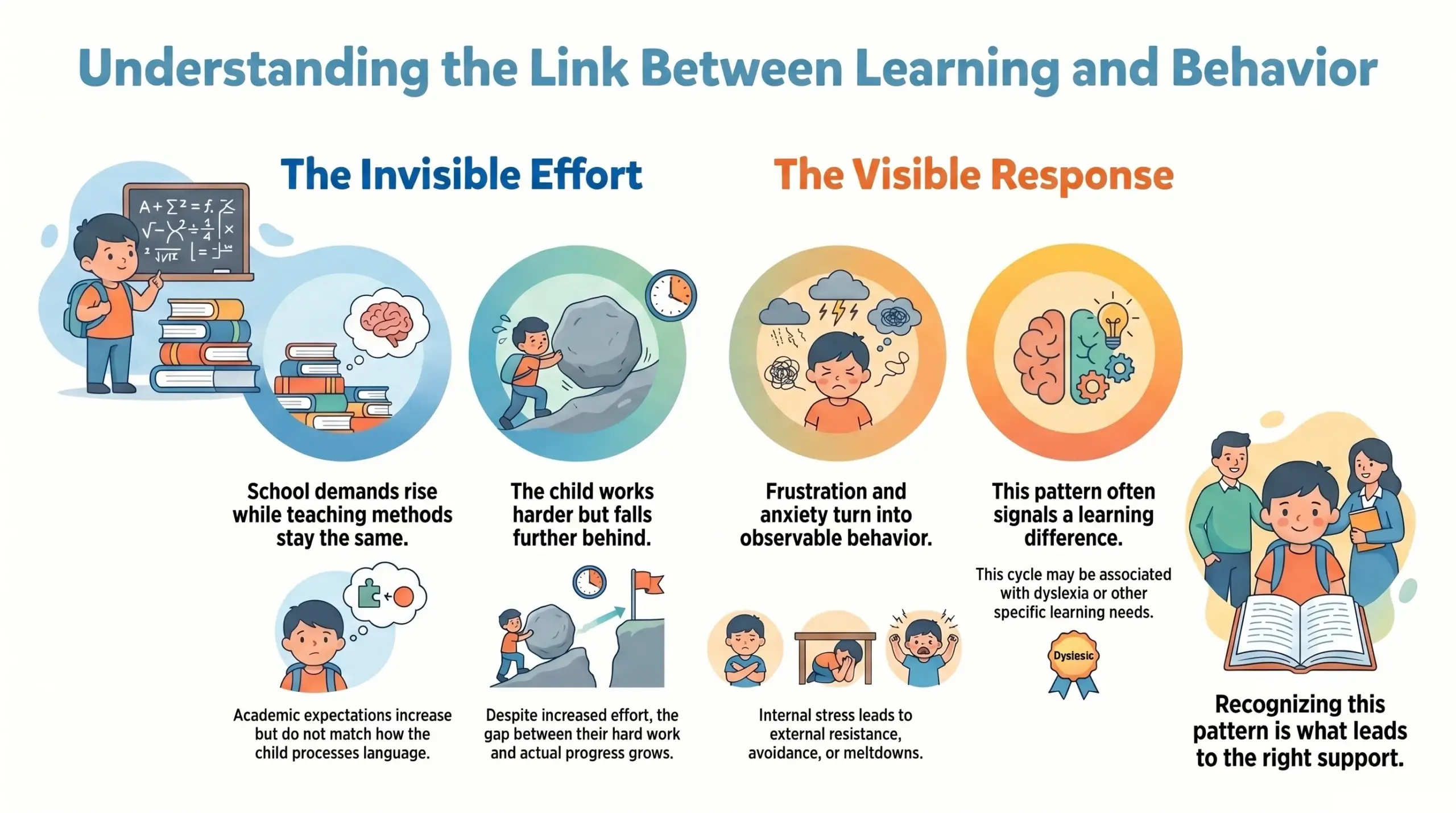
So what happens? They try harder, take more time, get the extra help, and still fall behind.
That is when things start to shift. Because when effort does not lead to progress, a child does not assume the method is wrong. They assume something is wrong with them.
That is where the frustration starts. The avoidance. The shutdown. Not because they are unwilling. Because they are stuck, and no one has shown them a way through it yet.
If you are seeing this pattern in your child, a dyslexia assessment provides the answers you need to stop guessing and start knowing.
What Changes in the Child When You Change the Instruction
Once you see the pattern, the next question is obvious: what actually works? If the issue is a mismatch between how a child is taught and how their brain processes language, then the solution is not more effort. It is a different instruction. That is what structured literacy was built to provide.
Structured literacy is direct, systematic, and cumulative. It does not assume a child will “pick it up.” It shows them exactly how written language works, step by step, in a way their brain can process. Instead of guessing at words, they learn how to break them apart. Instead of memorizing, they understand. Instead of falling further behind, they start to make sense of what they are seeing on the page.
And when that happens, something else changes. The frustration begins to ease. The resistance starts to drop. Confidence comes back, not because the child changed, but because the instruction did. At READ Academy, that is built into everything we do. We use structured, evidence-based programs designed specifically for students who have not responded to traditional instruction. The goal is not to push harder. It is to teach differently.
Wilson Reading System
Orton-Gillingham-based structured literacy for reading, spelling, and comprehension
Making Math Real
Multisensory math methodology for students who process numbers differently
Institute for Excellence in Writing (IEW)
Sequential, structured instruction in written expression for reluctant writers
Questions Parents Ask
Honest answers to the things families want to know.
Can reading difficulties cause anxiety in children?
Yes. A longitudinal study of nearly 24,000 children found that reading ability at age seven predicted emotional health at ages nine and eleven. The International Dyslexia Association identifies anxiety as the most frequent emotional symptom in children with dyslexia. The reading difficulty comes first. The anxiety follows.
Why did my child start struggling when school got harder?
Many children do well until reading demands increase. When instruction no longer matches how their brain processes language, the gap between effort and progress widens. That gap is what produces the frustration, avoidance, and emotional distress parents see at home and hear about from school.
Is this anxiety or a learning difference?
In many cases, both. The anxiety is real, but it is often a response to an underlying learning difference that has not been identified yet. If the anxiety centers on school and academics, a comprehensive learning assessment can identify what lies beneath it. The two are not mutually exclusive.
What is structured literacy and why does it work for anxious readers?
Structured literacy teaches reading explicitly through visual, auditory, and kinesthetic pathways. It reaches the parts of the brain that standard classroom instruction does not activate. When instruction finally matches how the brain processes language, the frustration caused by the mismatch begins to resolve. The anxiety was never about the child. It was about the method.
How do I know if my child needs a dyslexia assessment?
If your child is avoiding schoolwork, struggling despite effort, or showing anxiety in reading, writing, or math, a Comprehensive Dyslexia Assessment identifies the specific processing differences and the instruction your child needs. The assessment at READ Academy is led by Dr. Leah Skinner, ED.D., and costs between $895 and $995.
References
Research cited in this article.
Orton, S. (1925). Word blindness in school children. Archives of Neurology and Psychiatry, 14, 581-615. View source
Gillingham, A. & Stillman, B.W. (1935). Remedial Training for Children with Specific Disability in Reading, Spelling, and Penmanship. New York: Sackett & Wilhelms. View source
McArthur, G., Badcock, N., Castles, A., & Robidoux, S. (2022). Tracking the relations between children’s reading and emotional health across time: Evidence from four large longitudinal studies. Reading Research Quarterly, 57(2). View source
Jordan, J.A. & Dyer, K. (2017). Longitudinal evidence for the causal relationship between reading difficulties and emotional health. Cited in Frontiers in Education, 2024. View source
Sturm, V.E., Roy, A.R.K., Datta, S., et al. (2020). Enhanced visceromotor emotional reactivity in dyslexia and its relation to salience network connectivity. Cortex, 134, 278-295. View source
International Dyslexia Association. Social and emotional problems related to dyslexia. View source
Georgetown University Medical Center. Was Orton right? New study examines how the brain works in reading. ScienceDaily, 2003. View source
Academy of Orton-Gillingham Practitioners and Educators. Who were Orton and Gillingham? View source
About the Author
Dr. Leah Skinner, ED.D.
Founder, READ Academy of Sacramento | Certified Dyslexia Therapist
Dr. Leah is a Certified Dyslexia Therapist with a Doctor of Education in Reading, Literacy, and Assessment and a Master of Education in Dyslexia Specialization. She brings over 20 years of experience in structured literacy, dyslexia intervention, and educational advocacy. As the founder of READ Academy of Sacramento and READ AcademyREAD Learning Center and a mother of five neurodivergent sons, four of whom have dyslexia, she has spent two decades watching this from both sides of the table, as a clinician and as a mother.
WASC-accredited private school serving students with dyslexia and language-based learning differences.
Watch
When Emotions Run High: What the Research Says About Classroom Anxiety
Chapters
- 0:00 — The child who used to love school
- 0:37 — When the symptoms are a signal, not the problem
- 2:15 — Reading struggles come first, anxiety follows
- 3:02 — Nearly 100 years of evidence, from Orton to modern neuroscience
- 4:08 — UCSF brain scans confirm the emotional reality
- 5:08 — The instructional mismatch and why "try harder" fails
- 5:38 — Structured literacy: teaching differently, not harder
- 7:00 — The question that changes everything
Listen
Full audio narration with Dr. Leah Skinner, ED.D.
When Emotions Run High in the Classroom
Dr. Leah Skinner, ED.D., READ Academy
Chapters
- 0:00 — Introduction and key takeaway
- 0:51 — A note from Dr. Leah Skinner
- 1:49 — The pattern you are watching unfold
- 3:09 — Dr. Samuel Orton identified this pattern in 1925
- 5:11 — Modern science confirmed what Orton observed
- 7:43 — The instructional mismatch
- 8:38 — What changes when you change the instruction
- 9:58 — Questions parents ask
In This Episode
Dr. Leah Skinner narrates the full article on classroom anxiety and undiagnosed learning differences. From Dr. Samuel Orton’s 1925 observations to the 2020 UCSF brain imaging study, she walks through nearly 100 years of research explaining why the emotional distress parents see at home is often the signal of an instructional mismatch, not the root problem. Twelve minutes end to end.
Your child's anxiety at school may point to something deeper.
A Comprehensive Dyslexia Assessment identifies how your child processes language and what kind of instruction will actually work.
Give us a call
(916) 258-2080