
A Parent's Guide to IEPs and Reading
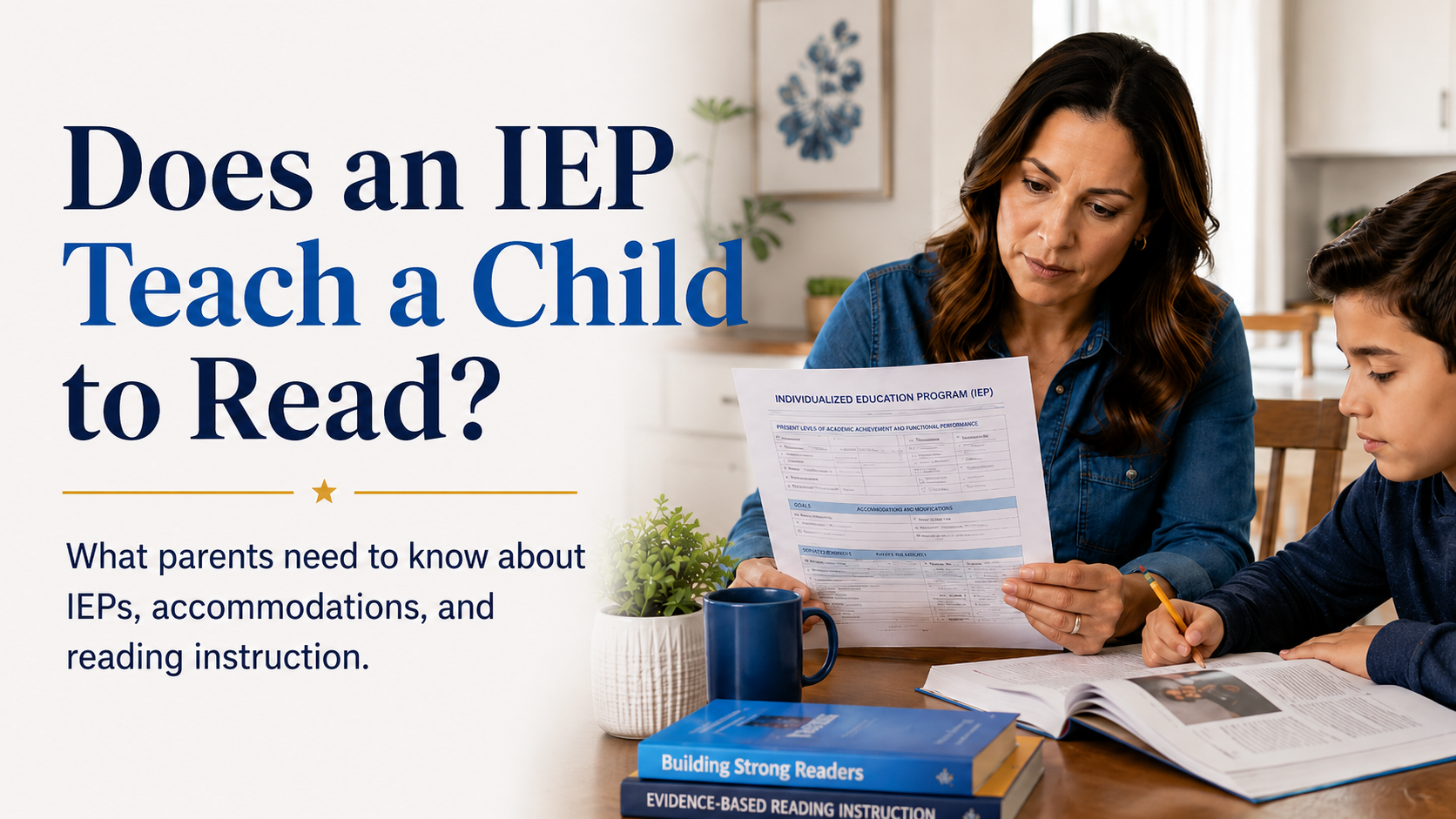
Does an IEP Actually Teach a Child to Read?
An IEP can require real reading instruction, or it can stop at accommodations. That difference decides whether your child actually learns to read.
By Dr. Leah Skinner, ED.D | June 2026
The Short Answer
- An IEP is a legal plan. It sets goals, services, and accommodations, but it does not, on its own, teach a child to read.
- Whether your child learns to read depends on what kind of help that plan actually contains: real reading instruction, or only accommodations.
- Accommodations like extra time, audiobooks, and text-to-speech help a child get through the school day. They do not build the ability to read.
- Reading is built by structured literacy: a named program, a trained provider, enough minutes each week, and goals that measure decoding and fluency.
The rest of this page walks through how to tell those two apart in your child’s plan, the five things a reading IEP has to include, and what to do if the school says your child does not qualify.
I have spent twenty-two years on the parents’ side of the IEP table, as an advocate and as the mother of four dyslexic sons. Here is what I watch families do again and again: they treat the signed IEP as the finish line. The meeting ends, a legal document exists, and everyone assumes the reading help must be somewhere inside it.
It may not be. An IEP is a framework, and what it actually does for your child depends entirely on the language the team writes into it. Two children with nearly identical scores can walk out with completely different plans. This guide shows you how to read yours, and the specific wording that separates a plan that teaches reading from one that only works around the problem.
Does an IEP teach a child to read?
Not by itself. An IEP is a legal plan that sets goals, services, and accommodations. Whether it teaches reading depends on the instruction written into it.
To build reading skill, the plan has to name explicit, structured literacy instruction. Accommodations alone, like extra time or audiobooks, let a child cope with grade-level work but never teach them to decode. A plan built only on accommodations can be followed to the letter while a child’s reading stays exactly where it started.
IEP accommodations vs. specially designed instruction
Every line in an IEP is doing one of two jobs, and only one of them actually teaches a child to read. Once you can see which is which, you can read your child’s plan and know, line by line, what it will really do for them.
Accommodations work around the reading
Extra time, audiobooks, text-to-speech, shorter assignments, a seat near the teacher. These lower the barriers so your child can keep up with grade-level material despite the reading difficulty. They matter, and most struggling readers need them. But accommodations never teach reading. A child can receive them for years and still not be able to read at the end of it.
Specially designed instruction teaches the reading
Direct, systematic structured literacy, built on approaches like Orton-Gillingham or the Wilson Reading System, delivered by someone trained to teach it, several sessions a week, with goals that track decoding and fluency. This is the part that rewires how a child maps sound to print. This is the part that moves a reading score.
Here is the way I explain it to parents. An accommodation is the ramp that gets a child into the building. Instruction is the therapy that helps them walk. Most plans are generous with ramps and thin on therapy. So when you read your child’s IEP, look past the accommodations and find the instruction. If you cannot find it, it usually is not there.
Five things a reading IEP must include
When a plan is meant to teach reading, these five things are what give it teeth. Leave any one of them out and the plan can still read well on paper while doing almost nothing in practice.
The reading IEP checklist
- A program named by name. “Specialized academic instruction” is a category, not a method. Ask which structured literacy program the plan uses, written in by name. If no one can name it, there usually is not one.
- A provider trained to deliver it. Federal law does not require a specific credential to teach reading under an IEP. So ask who delivers the instruction and what training they have in that exact program.
- Frequency that can move a gap. Structured literacy works through repetition. Twenty minutes once a week will not close anything. Look for the minutes per session and sessions per week, written into the plan rather than promised out loud.
- Goals that measure real reading. Decoding accuracy, words correct per minute, spelling, and phonemic awareness, each with a baseline, a target, and a date. “Will improve reading comprehension” is not a goal anyone can be held to.
- Progress data you actually see. Numbers every few weeks, sent to you, so you can watch the trend long before the annual review tells you it did not work.
Five questions that surface all of this in one meeting
- Which structured literacy program are you using, by name?
- Who delivers it, and how are they trained in that program?
- How many minutes, how many times a week, and is that written into the plan?
- What are the measurable decoding and fluency goals, with baselines and target dates?
- How often will you send me progress data so I can see the trend?
If your child’s plan answers all five, you have an IEP that teaches. If it is mostly accommodations, you have a plan that helps your child cope, and now you understand why it can be followed perfectly while the reading stays stuck.
What to do if the school says your child doesn’t qualify for an IEP
This is the wall a lot of families hit. The struggle is obvious at home, but the school says the scores are not low enough to qualify and offers a 504 plan instead. Here is the thing to hold onto: a 504 is accommodations only, so it can make the school day easier, but it cannot teach your child to read. You can request a special education evaluation in writing at any time, and the school has to either evaluate or put its refusal in writing. If you disagree with what they find, you can ask for an independent evaluation.
And underneath all of it sits the part that matters most. Qualifying and needing help are two different questions. A child can be turned down for an IEP and still need serious reading help. The eligibility decision tells you what the district is willing to provide. It tells you nothing about what your child actually needs.
Getting reading instruction when the IEP can’t deliver it
Start by pushing to get those five elements written into the document: the program by name, the trained provider, the weekly minutes, the measurable goals, the progress reports. Some schools will deliver all five. Many can’t, and no amount of meetings changes what a stretched system has the capacity to do. When the plan can’t carry the instruction, or carries it in name only, the next honest step is reading help that comes from outside the school day, or a school built around it from the start. If you want to know exactly what your child needs first, a comprehensive dyslexia assessment pinpoints it. And when you are ready to see what it looks like for reading to be the whole school rather than a service squeezed into the margins, come tour READ Academy.
You don’t need a better meeting. You need a better-written plan.
An IEP is not a cure. It is the record of what your child has been promised, no more and no less. What you have now is the language that turns that promise into actual teaching: the named program, the trained provider, the weekly minutes, the measurable goals, the progress data. Read your child’s plan against that short list, and whatever is missing from it is your next conversation.
If the plan isn’t working, it’s time for a different conversation.
IEP and reading: questions parents ask us most
Plain answers to what families want to know.
Does an IEP teach a child to read?
Not by itself. An IEP is a legal plan that sets goals, services, and accommodations. Whether it teaches reading depends on the instruction written into it. To build reading skill, the plan must name explicit, structured literacy instruction, delivered often enough to matter, not just accommodations like extra time or audiobooks.
Will an IEP fix my child's reading, or just add accommodations?
It depends on the document. Many IEPs are mostly accommodations, like extra time, audiobooks, and reduced workload, which help a child cope but do not build skill. An IEP only improves reading when specially designed instruction is written in: a named structured literacy program, a trained provider, several sessions a week, and measurable decoding and fluency goals.
Will an IEP include structured literacy or Orton-Gillingham instruction?
Sometimes, but it is not automatic. Plans often list a service like specialized academic instruction without naming a method, and federal law does not require a specific type of teacher to deliver it. Ask directly which program is used, by name, who delivers it, what training they have, and how many minutes per week. Vague answers usually mean vague instruction.
What reading goals should a dyslexia IEP include?
Specific, measurable goals for the skills reading is built on: decoding accuracy, oral reading fluency in correct words per minute, spelling, and phonemic awareness, each with a baseline, a target, and a date. A goal like will improve reading comprehension is too broad to track. If you cannot tell from the goal whether your child met it, it needs to be rewritten.
What is the difference between an IEP and private reading tutoring?
An IEP governs what the school provides during the school day, and the district controls what goes in it. Private structured literacy instruction is arranged by you, starts when you decide, and is usually one-on-one with a specialist you choose. Many families do both: the IEP for support at school, outside instruction to close the gap faster.
What if the school says my child doesn't qualify for an IEP?
You can request a special education evaluation in writing at any time, and the school must either evaluate or explain its refusal in writing. You can also dispute the results and request an independent evaluation. Remember that qualifying and needing help are different questions: a child can be denied an IEP and still need reading intervention, which is where private structured literacy instruction comes in.

Watch: Does an IEP Teach a Child to Read?
Dr. Leah Skinner, on camera: how to tell whether a plan is teaching reading, and what to ask if it isn’t
Opens the full video on our watch page. Captions are available on the video.
Listen: Does an IEP Teach a Child to Read?
The full guide, narrated by Dr. Leah Skinner, Ed.D.
Does an IEP Actually Teach a Child to Read?
Narrated by Dr. Leah Skinner, Ed.D.
Chapters
- 0:00 — Why a signed IEP is not the finish line
- 0:36 — Does an IEP teach a child to read? The direct answer
- 1:43 — Accommodations vs. specially designed instruction
- 2:55 — Five things a reading IEP must include
- 4:24 — Five questions to ask in the meeting
- 4:56 — What if the school says your child doesn't qualify?
- 6:02 — Getting reading instruction when the IEP can't deliver it
- 6:37 — Your next conversation with the IEP team
See what reading instruction looks like when it's the whole school.
A comprehensive dyslexia assessment tells you exactly what your child needs. A tour of READ Academy shows you what a school built entirely around structured literacy feels like from the inside.
or call (916) 258-2080