

Dyslexia
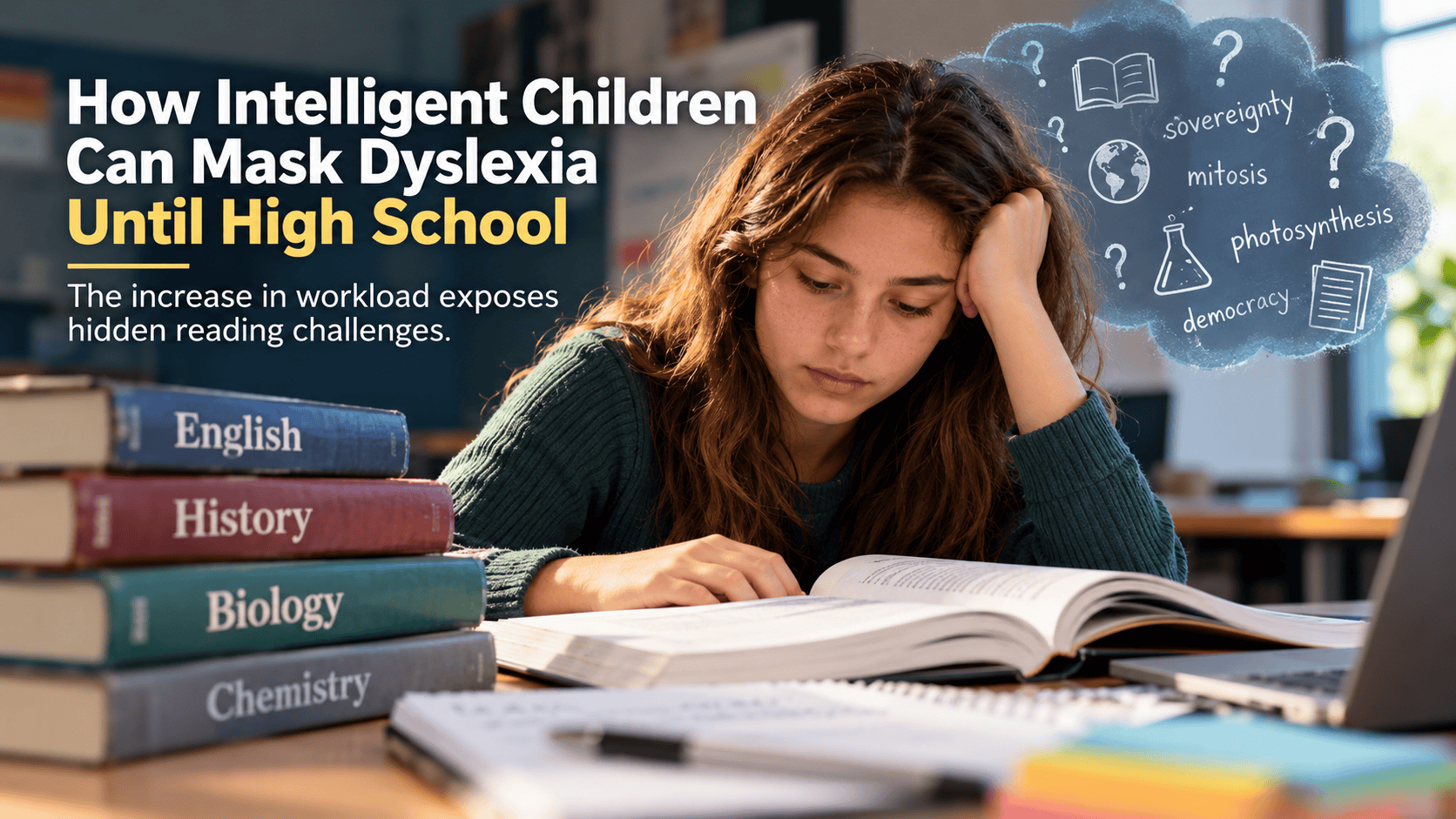
How Intelligent Children Can Mask Dyslexia Until High School
The increase in workload can be the tipping point that exposes dyslexia hidden in plain sight for years.
By Dr. Leah Skinner, ED.D | September 2026
Dyslexia can go undiagnosed until high school. Smart students hide it for years by guessing words from context and leaning on a strong vocabulary. The heavier high school workload is often what finally exposes the gap. Once identified, high schoolers need both school accommodations to keep up in class and structured literacy remediation to build the reading skill itself.
Key Takeaway
- If your teen is smart, their strong vocabulary and knack for guessing words from context can hide dyslexia for years.
- The challenging new vocabulary and increased workload of high school often expose difficulties your teen was previously able to compensate for.
- If your teen reads every word right but takes far longer than other students, ask for a dyslexia evaluation.
- It’s never too late to get the right instruction. When accommodations alone aren’t enough, remediation helps struggling readers at any age and sets them up to be lifelong learners.
How dyslexia can stay hidden in plain sight before high school
A smart student with dyslexia can cover for it by guessing words from the rest of the sentence. If your teen can read “dog” and “yard,” then “The dog dug a ___ in the yard” gives the missing word away. Out loud, that sounds like reading. University of York researchers found that children with dyslexia use sentence context this way to make up for words they can’t sound out.
Yale research on reading and IQ shows that very smart students can have dyslexia. Being gifted can even make the dyslexia harder to see. In a 2016 study of 121 primary school children in the Netherlands, gifted children with dyslexia read and spelled better than other dyslexic children but scored below typical readers. In-between scores like that may not look like dyslexia on paper. The researchers think strong vocabulary, grammar, and memory helped those children compensate, and they call the effect masking.
How a change in high school workload can expose dyslexia
High school can expose dyslexia because it adds more reading and more new words than a teen can get through by guessing. In one week, your teen might have a novel for English, a textbook chapter for history, and a long biology assignment. A slow reader can understand every page and still run out of hours. Then assignments go in unfinished. From the outside, that looks like a motivation problem.
Guessing a word from the rest of the sentence works when your teen already knows that word by ear. Textbooks are full of words a ninth grader may never have heard, like “sovereignty” or “mitosis.” A word that new has to be sounded out. That’s the step dyslexia makes hard.
Many gifted teens with dyslexia go unnoticed, according to a 2026 study of 111 students ages 11 to 17 in Spain. Researchers call students who are both gifted and dyslexic twice-exceptional. These teens tend not to stand out as strong or weak, so no one looks closer. The study adds that harder work, more complex reading, and more studying on their own in the teen years may expose the reading problems these teens had been covering for.
Signs of dyslexia in teens
Signs of dyslexia in teens include slow reading with good understanding, weak spelling, avoiding reading, trouble with a foreign language, and trouble with math word problems. A teen who reads every word right but takes far longer than other students may have dyslexia. The International Dyslexia Association says dyslexia makes reading words slow, inaccurate, or both, and the slow kind is easy to miss in a teen with good grades. Time a chapter of homework reading. If it takes your teen much longer than the teacher expects, ask for an evaluation.
The Mayo Clinic lists these signs of dyslexia in teens. Here’s what each one can look like in high school.
- Taking an unusually long time on reading or writing tasks. A history chapter the teacher expects to take 30 minutes takes your teen most of the evening.
- Trouble reading, including reading out loud. Your teen stumbles over long words in class or finds reasons to skip a turn.
- Weak spelling. Essays have spelling mistakes in words your teen uses correctly in conversation.
- Avoiding activities that involve reading. Your teen leans on video summaries and skips the assigned pages.
- Mispronouncing names or words, or struggling to find the right word. Long vocabulary words come out with syllables swapped, or the word stalls on the tip of the tongue.
- Difficulty summarizing a story. Your teen gets to the end of a chapter and can’t say what happened, because sounding out the words used up all their attention.
- Trouble learning a foreign language. Spanish or French class is a struggle, since it means learning a brand-new set of sounds and spelling rules.
- Difficulty with math word problems. Your teen handles the equations and misses the word problems.
Compare how your teen talks with how they spell. A teen who explains ideas like a strong student and spells like a struggling one is showing you the gap between what they understand and what they can get down on paper. Bring a few writing samples to any evaluation.
Teens who struggle to read are more likely to be anxious. A 2019 review of 34 studies with more than 16,000 people found that poor readers had more anxiety than typical readers, and somewhat more depression. If your teen has started dreading school or finding reasons to skip class, that can be part of the same problem.
Does remediation still help in high school?
Yes, remediation still works in high school. A 2015 University of Texas review of three decades of research found that reading programs helped struggling readers in grades 4 through 12, with no significant difference between grade levels.
The University of Texas review also found that even typical students gain little on standardized reading tests late in high school. Most of the programs it studied ran for less than a school year, and students still gained close to a year’s worth of typical reading growth. For high schoolers, the gains on standardized tests were too small to be sure of, so ask any program how it measures your teen’s reading progress besides those tests.
It isn’t too late even after high school. In a 2004 Georgetown University study, adults with dyslexia who got tutoring in sounding out words improved, and brain scans showed the change.
Your teen needs accommodations and remediation
Accommodations get your teen through this year’s classes, and remediation builds the reading skill itself. Ask for extra time on tests in your teen’s IEP or 504 plan, along with audiobooks or text-to-speech for grade-level reading. A 2018 Florida State University review found across 22 studies that read-aloud tools like text-to-speech gave students with reading disabilities a modest boost in comprehension.
Keep accommodations in the plan even as reading improves, because speed can lag behind accuracy for years. In a 2001 study of 8- to 10-year-olds with severe reading disabilities, each child got 67.5 hours of one-on-one instruction. Two years later, the group’s accuracy and comprehension were in the average range, and most of the children still read far too slowly. Yale researchers saw the same pattern in young adults whose reading accuracy had caught up after childhood reading problems.
Structured literacy teaches reading step by step. A trained teacher works through English sounds and the letters that spell them, in a set order, so your teen learns to sound out unfamiliar words. If your teen already has an IEP, our guide shows how to tell whether an IEP actually teaches reading.
Questions to ask a high school dyslexia program
- Which reading program, and how many minutes a day? Look for a named structured literacy program, like the Wilson Reading System, and get the daily minutes in writing.
- Who teaches it? Ask what training the teacher has in that specific program.
- How will my teen keep up in science and history? Look for labs and projects. Hands-on work means less of the content depends on reading.
- Who accredits the school? Listen for WASC. The California Department of Education says WASC accreditation generally ensures colleges and employers accept a school’s credits and diploma. Public schools, though, don’t have to accept private school credits, so if your teen might transfer later, ask how credits have moved for past students.
Our comparison of four Sacramento schools for dyslexic students checks accreditation, teacher training, and daily instruction at each one.
READ Academy’s dyslexia program for high school students
At READ Academy in Sacramento, reading instruction keeps going all the way through high school graduation. School runs four days a week, and a ninth grader here still gets 90 minutes of reading on every one of those days. The reading time is part of a 135-minute language arts block. The Wilson Reading System is our core reading program. Every teacher here has completed coursework or holds a certification related to dyslexia. Science and history are taught through experiments and projects, so your teen can learn those subjects hands-on while the reading work goes on.
Our full-time dyslexia school for grades 2 through 12 is WASC-accredited and takes students at any reading level. Most of our students arrive years behind in reading, writing, or math. I oversee every admission myself, and after a placement assessment I decide where each student starts. We keep a ratio of four students to every teacher.
“My daughter attended Read Academy for two years as a freshman and sophomore as well as summer school. It made all the difference in helping her get caught up to grade level in reading and writing. She then transferred to a local charter high school and will be going to college next year.”
If this sounds like your teen, let’s talk.
Questions parents ask about dyslexia in high school
How do I get my teenager tested for dyslexia?
Ask your school district in writing for a special education evaluation. Federal law lets you request one, and once the district agrees to evaluate, the evaluation costs you nothing. In California, the district has 15 days to send you an assessment plan, and school vacations longer than five school days don’t count toward the 15. A school evaluation decides whether your teen qualifies for special education and may not name dyslexia. If you disagree with the results, you can ask for an independent evaluation at public expense, or book a private dyslexia assessment.
Was my teen screened for dyslexia in elementary school?
No, not under California’s screening law. The state’s required reading screening covers kindergarten through second grade and started no later than the 2025-26 school year. Every current high schooler had finished second grade by then. Ask your district whether it screened your teen on its own. The California Department of Education says the state’s screening results aren’t a diagnosis, so treat any screening as a first look.
Will my teen’s IEP or 504 plan carry over to the SAT?
Usually, yes, once College Board approves a request. Start with your teen’s school. Its SSD coordinator sends requests to College Board’s Services for Students with Disabilities. Most students with an IEP or 504 plan then get their current accommodations approved automatically for College Board exams, including the SAT and AP. Approval can take up to seven weeks, longer if more documents are needed, so start well before test day. The ACT is different. ACT has to approve accommodations before test day, and your teen’s school submits that request. It’s due by the regular registration deadline.
When does my teen’s IEP have to plan for life after high school?
In California, an IEP has to plan for life after high school starting when your teen starts high school. State law sets that as the time to add goals for education, training, and work after graduation, plus the services to reach them. Federal law allows waiting until 16, and if the IEP team wants to wait, California law encourages it to explain why. Ask for transition planning at your teen’s first high school IEP meeting.
Can my school district pay for a private high school?
Yes, in some cases. Students with IEPs from Sacramento-area districts attend READ Academy with tuition paid by their district. When a district hasn’t offered an appropriate education, a hearing officer or court can order it to repay tuition at a suitable private school. The Supreme Court has ruled that this can apply even to a child who never received special education. Talk with a special education attorney or advocate before you act, because the order of steps matters. Repayment isn’t automatic, and you may have to pay tuition up front while you seek it. Our tuition reimbursement guide covers each step, and our free 10-day notice letter builder helps you write the required notice.
Can my teen enroll at READ Academy without a diagnosis?
Yes. Many of our students arrive without a formal diagnosis. If your teen doesn’t have a current evaluation, a dyslexia assessment is usually the first step before placement. Our admissions process walks you through each step.
Is it dyslexia or ADHD?
It can be both. The International Dyslexia Association estimates that 30 percent of people with dyslexia also have ADHD. If your teen already has an ADHD diagnosis and still reads slowly, ask for a reading evaluation too, because treating the attention problem alone won’t fix the reading.
Will my teen’s IEP follow them to college?
No. Colleges have no obligations under IDEA, the federal special education law, so the IEP ends at graduation. To get accommodations, your teen has to tell the college’s disability office about the dyslexia, and the college doesn’t have to pay for a new evaluation. Get a current evaluation done before senior year so the paperwork is ready.
Prefer to watch? How Smart Kids Hide Dyslexia Until High School — a 5-minute video on why bright children get missed, and what still helps at fifteen.
Sources
- Nation, K., & Snowling, M. J. (1998). Individual differences in contextual facilitation: Evidence from dyslexia and poor reading comprehension. Child Development, 69(4), 996-1011.
- Ferrer, E., Shaywitz, B. A., Holahan, J. M., Marchione, K., & Shaywitz, S. E. (2010). Uncoupling of reading and IQ over time: Empirical evidence for a definition of dyslexia. Psychological Science, 21(1), 93-101.
- van Viersen, S., Kroesbergen, E. H., Slot, E. M., & de Bree, E. H. (2016). High reading skills mask dyslexia in gifted children. Journal of Learning Disabilities, 49(2), 189-199.
- Alonso Benito, S., Pérez Sánchez, L. F., & Bueno Villaverde, Á. (2026). Reading and writing profiles in twice-exceptional adolescents with intellectual giftedness and dyslexia. Journal of Intelligence, 14(6), 108.
- International Dyslexia Association. (2025). Definition of Dyslexia.
- Mayo Clinic. Dyslexia: Symptoms and causes.
- Francis, D. A., Caruana, N., Hudson, J. L., & McArthur, G. M. (2019). The association between poor reading and internalising problems: A systematic review and meta-analysis. Clinical Psychology Review, 67, 45-60.
- Scammacca, N. K., Roberts, G., Vaughn, S., & Stuebing, K. K. (2015). A meta-analysis of interventions for struggling readers in grades 4-12: 1980-2011. Journal of Learning Disabilities, 48(4), 369-390.
- Eden, G. F., Jones, K. M., Cappell, K., Gareau, L., Wood, F. B., Zeffiro, T. A., Dietz, N. A., Agnew, J. A., & Flowers, D. L. (2004). Neural changes following remediation in adult developmental dyslexia. Neuron, 44(3), 411-422.
- Wood, S. G., Moxley, J. H., Tighe, E. L., & Wagner, R. K. (2018). Does use of text-to-speech and related read-aloud tools improve reading comprehension for students with reading disabilities? A meta-analysis. Journal of Learning Disabilities, 51(1), 73-84.
- Torgesen, J. K., Alexander, A. W., Wagner, R. K., Rashotte, C. A., Voeller, K. K. S., & Conway, T. (2001). Intensive remedial instruction for children with severe reading disabilities: Immediate and long-term outcomes from two instructional approaches. Journal of Learning Disabilities, 34(1), 33-58.
- Shaywitz, S. E., Shaywitz, B. A., Fulbright, R. K., Skudlarski, P., Mencl, W. E., Constable, R. T., Pugh, K. R., Holahan, J. M., Marchione, K. E., Fletcher, J. M., Lyon, G. R., & Gore, J. C. (2003). Neural systems for compensation and persistence: Young adult outcome of childhood reading disability. Biological Psychiatry, 54(1), 25-33.
- California Department of Education. Private Schools Frequently Asked Questions.
- 34 CFR § 300.301. Initial evaluations. Electronic Code of Federal Regulations.
- Center for Parent Information and Resources. Evaluating School-Aged Children for Disability.
- California Education Code § 56321. California Education Code section 56321. California Public Law.
- California Department of Education. Screening for Risk of Reading Difficulties FAQs.
- College Board. Requesting Through the School.
- College Board. If the student has an IEP or 504 plan in place, do they still need to submit a request for accommodation?
- College Board. What types of formal school plans qualify for automatic approval?
- College Board. Know Your Dates and Deadlines.
- ACT. Requesting Accommodations for the ACT Test.
- California Education Code § 56043. California Education Code section 56043. California Public Law.
- 34 CFR § 300.320. Definition of individualized education program. Electronic Code of Federal Regulations.
- 34 CFR § 300.148. Placement of children by parents when FAPE is at issue. Electronic Code of Federal Regulations.
- Forest Grove School District v. T. A., 557 U.S. 230 (2009). Opinion of the Court. Legal Information Institute, Cornell Law School.
- International Dyslexia Association. Attention-Deficit/Hyperactivity Disorder (AD/HD) and Dyslexia.
- U.S. Department of Education, Office for Civil Rights. (2011). Transition of Students With Disabilities to Postsecondary Education: A Guide for High School Educators.